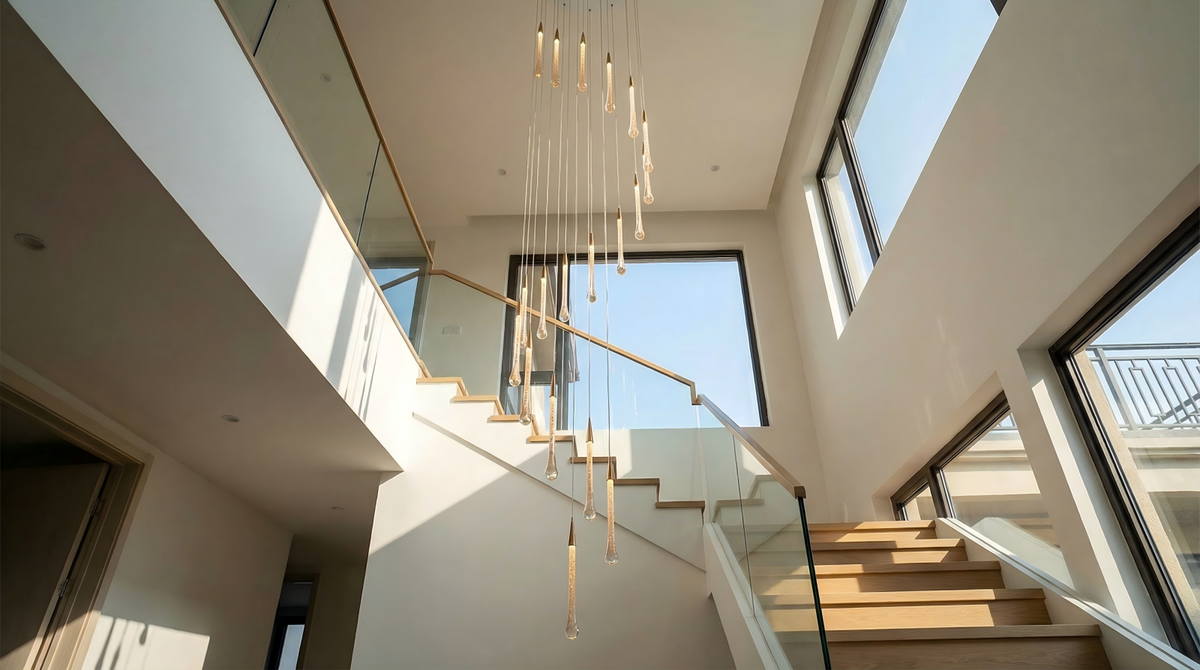
A staircase is the one place in a house where you see a light fixture from three angles at once — from the hall below, from partway up the stairs, and from the landing above. That is what makes stairwell lighting harder than any other room, and also what makes it worth getting right. A well-chosen fixture reads as sculpture from every one of those positions.
This guide covers the four fixture types that work in stairwells, how to choose between them, and the practical details to check before you order.
Why stairwells need a different approach
Most rooms are lit horizontally: you fill a floor area. A stairwell is the opposite — you are filling height. A fixture that looks generous over a dining table can vanish entirely in a two-story stairwell, because the eye reads it against fifteen or twenty feet of empty vertical space rather than against a tabletop.
That leads to one rule that governs everything else: in a stairwell, choose length over width. A staggered cascade of small pendants fills the volume far better than a single wide fixture, and it gives you something to look at from every landing.
Four fixture types that work
Cascading crystal
Long strands of crystal catch and throw light down the full height of a stairwell, and the staggered drop means there is always something at eye level from wherever you are standing. This is the most dramatic option and suits tall, narrow stairwells particularly well.
See the Staircase Raindrop Crystal Pendant or the Crystal Raindrop Cascade Chandelier.
Bubble and orb clusters
Hand-blown glass orbs give a softer, more contemporary effect. Because each orb is a discrete point of light, a cluster reads well from below and from above without any single viewing angle dominating. Good for wider stairwells and open-plan landings.
See the Gregg Pendant Lamp in organic white glass.
Sculptural single statements
Where a stairwell is short but the ceiling is high — or where the stair wraps a central void — a single sculptural piece can work better than a cascade. The form has to hold up in daylight as well as at night.
See the Sculptural Crystal Cascade.
Multi-light pendants
Multiple pendants suspended from one canopy give you control over the arrangement: you set each drop individually to follow the line of the stairs. This is the most adaptable option for an irregular or curved stairwell.
See the Meteors Crystal Chandelier.
Five things to check before you order
- Total drop. Measure from your ceiling to where you want the lowest point to sit, then check that figure against the maximum drop on the product page. Aurorae cables are adjustable and can be shortened on site during installation.
- The lowest point. Nothing should hang where someone can hit it. Keep clearance above the highest step the fixture passes over, not just above the floor.
- Junction box rating. A standard ceiling box supports up to about 35 lbs. Cascading fixtures with many crystal elements often exceed that, and need a braced box. Each product page lists the exact weight — give it to your electrician before installation day.
- Dimming. Many Aurorae fixtures are dimmable and work with standard TRIAC dimmers, but not all of them are. The product page states the dimming status for each fixture.
- Installation access. A tall stairwell usually needs scaffolding, and a stairwell is harder to stage than a flat hallway. Sort out access before the fixture arrives.
Coordinating with the rest of the house
In most homes, the stairwell fixture is visible in the same sightline as the entry chandelier and the upstairs landing light. The easiest way to make three separate fixtures look intentional is to keep the metal finish and the color temperature consistent, and let the shapes differ — a statement piece in the entry, a slimmer cascade over the stairs, something smaller on the landing.
Most Aurorae fixtures run a warm 3000K as standard, so pieces bought together already match. For the full sizing and hanging-height formulas, see our Foyer & Entry Lighting guide.
Specifications
Our fixtures are UL Listed for installation in the US and Canada, CE certified for European markets, and 110–240V compatible. All are rated for indoor dry-location installation.
Browse the full range in our chandelier collection and glass chandeliers.
Not sure which drop you need?
Send us your ceiling height, the height of the stairwell void, and a photo of the space. We will recommend a fixture and the exact drop. Email info@auroraeshop.com — we reply within 12 hours, Monday to Friday.
Returns are open for 30 days from delivery, and test installation is welcome, so you can power the fixture on and see the light in your own stairwell before deciding to keep it.
— By the Aurorae Team · Last updated: September 2026