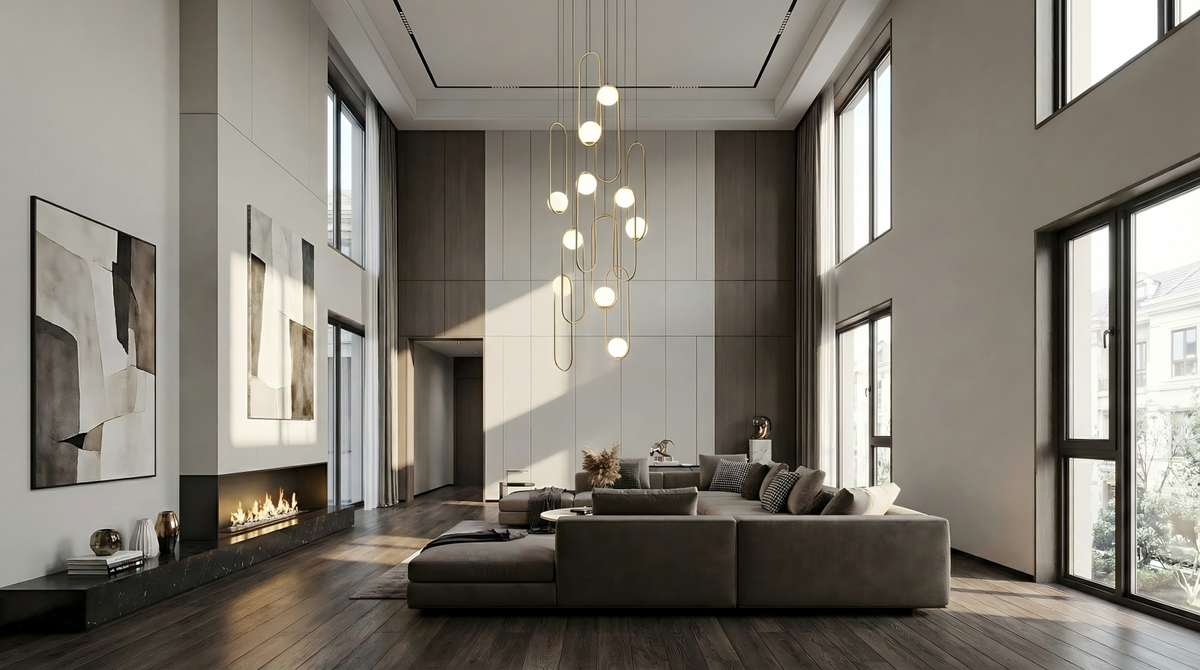
Walk into a room with the right light and you feel it before you notice it. The space reads calmer, ceilings feel higher, and everything in the room looks a little more deliberate. That is what a well-chosen minimalist chandelier does — and it is why so many modern homes have moved away from ornate multi-tier fixtures toward something quieter.
This guide covers what actually makes a chandelier minimalist, where the style works best, and the practical details worth checking before you buy one online.
What makes a chandelier minimalist
Minimalist is not the same as plain. A minimalist fixture earns its place through proportion and material rather than ornament, and there are a few things that separate a good one from a merely simple one:
- A clear silhouette. You should be able to describe the shape in one phrase — a cluster of orbs, a single ring, a vertical cascade. If it takes a paragraph, it is not minimalist.
- Material doing the work. Hand-blown glass carries visible swirl marks and slight thickness variations; K9 crystal throws distinct patterns across walls. These are the details that give a simple form depth.
- Diffused light, not glare. Frosted shades spread light evenly instead of creating hot spots. In an open-plan room, that difference is what makes a space feel restful rather than lit.
- Restraint in the hardware. Slim canopies, single-finish metalwork, no visible fixings. The fixture should read as one object.
Where a minimalist chandelier works best
Entryways and two-story foyers
A tall entry is the hardest space in the house to fill well, and it is where a minimalist fixture tends to outperform an ornate one. A vertical cascade or a cluster of glass orbs fills the height without visually crowding it. If a window sits above your front door, the fixture also becomes part of what people see from the street.
Getting the size and hanging height right matters more here than anywhere else in the house. We wrote a full guide on that — see Foyer & Entry Lighting for the diameter formula, drop calculations, and the 7-foot clearance rule.
Open staircases and stairwells
A stairwell is a vertical space viewed from several levels at once, which is why long-drop fixtures work so well there. The important practical point is cord length: Aurorae cables span from 60 inches up to 275 inches on our grand staircase designs, and they can be shortened during installation to suit your exact ceiling. The maximum length is listed on each product page.
Dining rooms
Over a dining table, the fixture sits closer to eye level than anywhere else, so diffusion matters. A frosted or hand-blown shade at a warm color temperature gives you light on the table without glare in anyone's face. This is also the room where dimming earns its keep — bright for homework, low for dinner.
Five things to check before you buy
Buying lighting online means you cannot hold the fixture up to the ceiling first. These five checks catch most of the problems people run into:
- Cord length. Confirm the maximum drop on the product page against your ceiling height. Adjustable cords let one fixture work in a 12-foot room or a 20-foot entry; fixed-length ones rarely fit a tall space.
- Dimming. Many Aurorae fixtures are dimmable, but not all — the product page states the dimming status for each one. Dimmable models work with standard TRIAC dimmers, including Lutron. Check before you wire in a dimmer switch.
- Color temperature. Most of our fixtures use 3000K warm white as standard. Select models are offered in 2700K for bedrooms, or 4000K and 6000K where a cooler, brighter light suits the task.
- Voltage and certification. Our fixtures are 110–240V compatible, UL Listed, and CE certified for European markets — so the same piece works whether you are in Chicago or Cologne.
- Ceiling box rating. Heavier fixtures need a braced or fan-rated junction box. Each product page lists the exact weight; give that figure to your electrician before installation day.
Materials, and why they matter more than finish
Finish is the easiest thing to choose and the least important. Material is what determines how a fixture ages and how it handles light.
- Hand-blown glass is shaped by breath, gravity, and heat rather than pressed into a mold. No two shades are identical, and the slight irregularities are what catch the light.
- K9 optical crystal is cut and polished one facet at a time. It refracts light into distinct patterns across surrounding surfaces — the effect you notice on a wall, not on the fixture itself.
- Solid walnut is finished with a matte, non-yellowing sealant that holds its warm mid-tone rather than ambering over the years.
- Natural marble gives weight and a soft, diffused glow that reads calm rather than decorative.
Metalwork is available in chrome, polished brass, gold, matte black, and white. If you are lighting a foyer, staircase, and landing that are all visible from the same spot, keep the finish and color temperature consistent across the three and let the shapes differ — that is the single easiest way to make separate fixtures look like one considered scheme.
Where to start
If you know the room but not the fixture, browse our chandelier collection or narrow to glass chandeliers. The Modern Minimalist Chandelier is a good starting point for anyone weighing the style — a clean form that suits dining rooms, entryways, and open living spaces equally.
Every Aurorae fixture comes with a 4-year warranty, and returns are open for 30 days from delivery. Test installation is welcome, so you can power the fixture on and see the light in your own space before deciding to keep it.
Not sure which size suits your room? Email info@auroraeshop.com with your ceiling height and a photo of the space, and we will recommend a diameter and hanging height. We reply within 12 hours, Monday to Friday.
— By the Aurorae Team · Last updated: September 2026