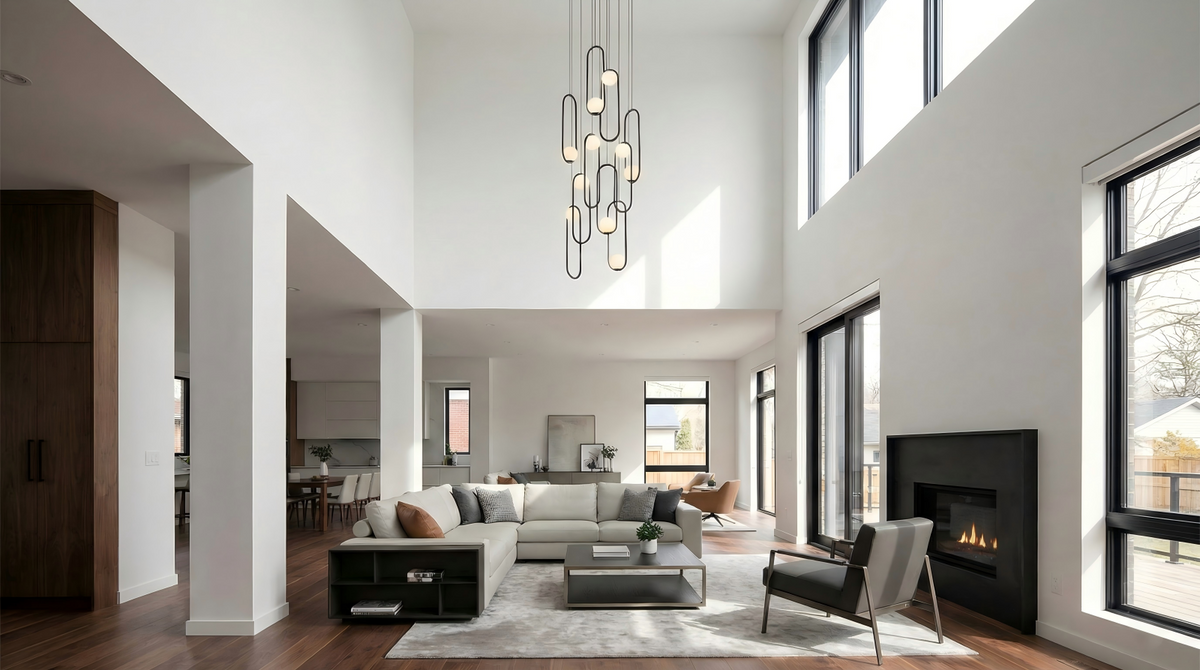
Lighting trends move slowly compared with furniture or paint, which is a good thing — a fixture is a ten-year decision, not a seasonal one. But a few clear directions have settled in for 2026, and most of them share a common thread: fewer fixtures, chosen more carefully.
Here are the five that matter, and what each one means when you are actually choosing a light for a room.
1. The fixture as sculpture
The biggest shift is that a chandelier is now expected to look good switched off. That sounds obvious, but it changes what makes a good design: form has to hold up in daylight, not just glow at night.
In practice this favours fixtures with a clear silhouette and honest materials — a cluster of hand-blown glass orbs, a vertical cascade of crystal, a single ring in brushed metal. It also means placement matters more. A sculptural piece needs room around it; crowding one into a tight corner wastes what you paid for.
2. Warm light, not bright light
The move away from cool white has finished. Warm 3000K light is now the default for living spaces, and for good reason: it flatters skin tones, makes wood and brass read richer, and does not turn a dining room into an office at seven in the evening.
Most Aurorae fixtures use 3000K warm white as standard. Select models are offered in 2700K for bedrooms, where an even softer light suits, or 4000K and 6000K where a room doubles as a workspace. Each product page lists the color temperature for that specific fixture.
One practical note: keep the color temperature consistent across fixtures that are visible from the same spot. Mixing 3000K and 4000K in one sightline is the most common reason a room feels subtly wrong without anyone being able to say why.
3. Layers instead of one central light
A single ceiling fixture doing all the work is the fastest way to make a room feel flat. The current approach is to treat lighting in three layers — ambient light for the overall level, task light where you actually do things, and accent light on the features worth noticing.
The chandelier's job in that scheme is usually ambient and architectural: it sets the mood and anchors the room, while lamps and directional fittings handle the rest. That frees you to choose a chandelier for how it looks rather than how much light it puts out.
4. Filling vertical space
Open-plan layouts and double-height entries have made vertical composition the harder problem. A wide fixture that works over a dining table can disappear entirely in a twenty-foot stairwell.
The answer is a longer drop rather than a wider fixture: cascading or tiered designs that occupy height. Aurorae cables run from 60 inches up to 275 inches on grand staircase designs, and they can be shortened on site during installation — which matters, because tall spaces vary enormously from home to home and a fixed-length fixture rarely fits.
For the sizing formulas and hanging heights, see our Foyer & Entry Lighting guide.
5. Dimming as a baseline expectation
Dimming used to be an upgrade. It is now the first question buyers ask, because a fixture that only has one brightness setting only suits one occasion.
Worth checking before you buy: many Aurorae fixtures are dimmable and work with standard TRIAC dimmers including Lutron, but not all of them are. Fixtures with integrated LED modules dim through a driver in the canopy, so a model without that driver cannot be dimmed. Each product page states the dimming status for that fixture — check it before you have a dimmer switch wired in.
What actually makes lighting sustainable
Sustainability in lighting gets discussed mostly in terms of materials, but the honest answer is simpler: the most sustainable fixture is the one you do not replace.
That comes down to two things — whether the design will still look right in ten years, and whether the fixture is repairable. On the second point, our fixtures are covered by a 4-year warranty against manufacturing defects, and most warranty claims are resolved by shipping the affected component rather than replacing the whole piece. A crystal element or an LED module can be swapped; the fixture stays on the ceiling.
On the first point, that is exactly why restrained shapes have held their ground while more decorative trends have come and gone.
Where the minimalist chandelier fits
The modern minimalist chandelier sits at the intersection of most of the above: a clear sculptural form, warm diffused light, an adjustable drop that suits tall spaces, and a shape that does not date. That combination is why it has stayed at the centre of modern lighting rather than passing through as a trend.
The Modern Minimalist Chandelier is a straightforward place to start — see the product page for available configurations, finishes, and dimming status. Every Aurorae fixture is UL Listed, CE certified for European markets, and 110–240V compatible.
Browse the full range in our chandelier collection or narrow to glass chandeliers.
Choosing for your room
If you know the room but not the fixture, send us your ceiling height, room dimensions, and a photo of the space. We will recommend a diameter and hanging height. Email info@auroraeshop.com — we reply within 12 hours, Monday to Friday.
Returns are open for 30 days from delivery, and test installation is welcome, so you can power the fixture on and see the light in your own room before deciding to keep it.
— By the Aurorae Team · Last updated: September 2026